Hoskier and Ligatures

EDIT: My next post updates this one, as I was mistaken in this post. But I will leave it for the images and information / illustration of the difficulties of reading New Testament Greek Ligatures.

As I posted before, I am currently busy updating and improving the footnotes to my translation of the Revelation of John, “The Apocalypse of John.” One of the ways I am expanding the footnotes, is specifying which Vulgate manuscripts (not just editions) support what reading. Also, where the Textus Receptus is divided, specifying which editions read what.

In this process, I have found several places in which I disagree with H. C. Hoskier’s collation of the TR editions. I do not know if he was relying on someone else’s collations, or if he looked at the original documents themselves. But the problem lies in understanding the ligatures for letter combinations that are used in Greek cursive manuscripts, including the Greek New Testament editions made by Erasmus, Beza, Elzevir, and Stephens. Now, I possess PDF copies of the original cursive manuscripts of the following “Textus Receptus” editions. All 5 Erasmus editions, the 1550 Stephanus edition, the 1598 Beza edition, the 1624 Elzevir edition, plus the Complutensian Polyglot (1514).

Revelation 17:8 variant- καιπερ εστιν

There is a famous textual variant in Revelation chapter 17 verse 8 where the Textus Receptus disagrees with all Greek manuscripts and reads καιπερ εστιν. However, I found that I disagree with Hoskier regarding the readings of Erasmus’ editions 1, 3 and 4, as follows.

First, a snip showing what Hoskier says:

Erasmus Ed. 1 (1516): Hoskier says και περ is two words, I say one:

Erasmus Ed. 3 (1522) very clearly reads καί παρ, not καί περ:

Erasmus Ed. 4 (1527) very clearly reads καί παρ, not καί περ:

See here the difference- Erasmus Ed. 5 (1535) shows the ligature for περ:

I still offer my chart of Greek cursive ligatures for free (also thanks go to Vernon Eugene Kooy, PhD for his font). These above images and data are now included in my Revelation pdf, downloadable for free.

Armageddon

The word Armageddon is found only once in the Bible, in Revelation 16:16.  “And He gathered them together at the place called in Hebrew Harmagedōn.”

There is a great variety of spellings of the word in the Greek and Latin manuscripts of the New Testament.  But there are two main divisions of the spellings: those with just Magedon, and those with the AR in front.

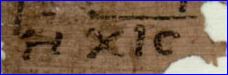
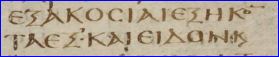
The earliest Greek manuscripts have αρμαγεδων.  Here is the image snipped from Codex Alexandrinus (Codex A), 5th century:

The Greek New Testament editions read as follows:

Ἁρμαγεδών  Antoniades, Robinson-Pierpont, SBL, and NA28

Ἀρμαγεδών  BG (Byzantine Greek), and TH (Tyndale House)

Ἀρμαγεδδών  TR (Textus Receptus)

The difference between the first two spellings is the “breathing mark” in front of or above the initial vowel.  The first one has a backwards apostrophe, and that is the “h” sound in Greek, so Harmagedon.”  The second and third spellings have a regular-facing apostrophe and so that has no “h” sound, thus Armagedon.

John tells us that it is a Hebrew name, so the Har would be Hebrew for mountain, and Magedō would be the place called Megiddo, mentioned in 2 Chronicles 35:22 and Judges 1:27.  So “Mountain of Megiddō.”  This was a frequent battleground because of a strategic pass and the Megiddo plain below. You can download here the book of Revelation with a fuller accounting of the readings in the Greek manuscripts.

Vulgate Manuscripts

In my ( David Robert Palmer ) translation documents, I provide a critical apparatus in the footnotes, indicating what ancient Greek, Latin and other manuscripts support which Greek text reading.  However, I have up to this point been dissatisfied with the citations of Latin Vulgate manuscripts.  I had been getting them from the footnotes of the Nestle-Aland and United Bible Societies’ editions, and also from, in the case of Revelation, on which I am currently working, H. C. Hoskier.

The problem I have with the Vulgate citations is that they are citing “editions.”  They are not citing particular manuscripts of a certain date, but editions of all of them.  For example, right now I am revising and expanding my footnotes in the Apocalypse of John.  Quite often, the Textus Receptus and the King James Version have a reading that is found in no Greek manuscript, but only in one edition of the Vulgate, the “Clementine” edition, which is indicated by the sigla vg cl in the apparatuses.  The majority reading in the same variant set may be supported by vg ww,st .  The st stands for Stuttgart, which comes from a 5th century edition.  The ww represents another critical edition, the Wordsworth-White.

Would it make a difference to you if you learned that the Clementine Vulgate dates from the year 1592, and was made for Pope Clement VIII?  But, this Vulgate too, is an edition which seeks to ascertain the earliest text, especially of Jerome, and has been updated with revisions, to a final edition in 1995.

It gets murky when I try to cite the Latin evidence.  A given Latin manuscript can be “Vetus Latina” or “Old Latin” in some books of the New Testament, while in Revelation or some other book, its text is considered “Vulgate” text.

So, for the Vulgate in Revelation I do use the sigla found in the UBS and NA footnotes for the Stuttgart, Wordsworth-White, and Clementine editions, but I also indicate when Hoskier or Tischendorf lets us know the readings of specific Vulgate manuscripts.  These are:

am – Codex Amiatinus, beginning of the VIII century
fu – Codex Fuldensis 541-546
tol – Codex Toletanus  950
dem – Codex Demidovianus XIII
harl – Codex Harleianus, second half of the IX century
lipss – 3 Leipzig Latin mss cited in Tischendorf 8th Edition

You can download my latest edition of the Revelation of John here.

Lilith?

Here are 50 Bible versions’ rendering of Isaiah 34:14

KJ21 the satyr; the screech owl
ASV the wild goat; the night-monster
AMP the hairy goat; Lilith (night demon)
AMPC the [shaggy] wild goat; the night monster
Bishops the wylde: the Lamia
Brenton satyrs: satyrs
BRG the satyr; the screech owl
HCSB wild goat. the screech owl
CSB wild goat. the night birds
CEB the goat demon, Lilith
CJB billy-goats; Lilit [the night monster]
CEV demons, creatures of the night
DARBY the wild goat; the lilith
DRA the hairy ones, the lamia
ERV Wild goats. Night animals
EHV wild goats. Creatures of the night
EXB wild goats. Night animals
Geneva the Satyr, the screech owl
GW Male goats. Screech owls
GNT demons. The night monster
ICB wild goats. Night animals
ISV goat-demons. Liliths
JUB the satyr; the screech owl
KJV the satyr; the screech owl
AKJV the satyr; the screech owl
LSB The hairy goat; the night creature
LEB a goat-demon; Lilith
MEV the wild goat; the screech owl
NOG Male goats. Screech owls
NAB satyrs; the lilith
NASB The goat. the night-bird
NASB95 The hairy goat; the night monster
NCB wild goats, the nightjar
NCV wild goats. Night animals
NET wild goats. nocturnal animals
NIRV Wild goats. Night creatures
NIV wild goats; the night creatures
TNIV wild goats, the night creatures
NKJV the wild goat; the night creature
NLV The wild goats. the night-demon
NLT Wild goats, night creatures
OJB sa’ir (wild goat), lilit (night creature)
RSV the satyr; the night hag
NRSV goat-demons; Lilith
ESV the wild goat; the night bird
TLV the goat-demon— the night monster
VOICE demons, Lilith herself
WEB the wild goat. the night creature
WYC an hairy, Lamia
YLT the goat, the night-owl

Revelation 21:6 Theory

“they are accomplished I am”

a. γεγοναν εγω ειμι A 1678 1778 TH NA28 [ειμι] {\}

b. γεγοναν εγω ℵ²a SBL

c. γεγονασιν εγω ειμι 254 469 1006 1841 2020 2053 2062 2065 2078 2080 2436

“it is accomplished I am”

d. γεγονεν εγω ειμι 2087? TR AN

“it is accomplished” ?!

e. γεγονεν 149 368 386 1948 2021 2025 2028 2029 2033 2044 2054 2068 2069? 2083 2305 2349

‘I am become I am”

f. γεγονα εγω ειμι 2060 cop-sa 

“I am / I am become”

g. γεγωνα 2196

h.  εγω ειμι Beat Ps-Ambr

i. εγω ℵ²b syr-h-mss ?

j. γεγωνα εγω 181 616 680 2030 2082 syr-h-mss ?

k. γεγονα εγω ℵ* P 046 051S 35* 42 91 104 172 175 203 205 205 209 241 242 250 367 424 506 617 632mg? 664 699 792 922 1094 1384 1611 1732 1854 1862 1876 1888 1934 2014 2016 2017 2018 2026 2031 2034 2036 2037 2038 2042 2043 2045 2046 2047 2050 2056 2057 2058 2070 2073 2074 2075 2076 2077 2079 2081c 2084 2254 2258 2286 2329 2595 syr-h 

l. γεγονα 18 35c 61 82 93 110 141 177 180 325 336 337 367 385 429 432 452 456 467 498 517 522 582 620 627 632* 743 757 808 824 920 935S 986? 1072 1075 1248 1328 1352² 1503 1551 1597 1617 1637 1704 1719 1728 1733 1734 1745 1746 1771 1849 1852 1859 1864 1865 1893 1894 1918? 1957 2004 2023 2024 2027 2035 2039 2041 2048 2051 2055 2061 2064 2067 2071 2081* 2138 2186 2814 2821 HF BG RP

m. γεγοναι 2059

lacunose C 052 69 88 94 218 256 314 459 468 628 911? 919 1626 1740 1774 1828 1955 2015 2019 2022 2032 2052 2302 2040 2200 2256 2351

I am lately inclined to think as follows.  The k or l variant was original, but copyists not fluent in LXX or Koine Greek took its meaning by lexical glosses only, as “I am become the Alpha and Omega.”  This seemed doctrinally incorrect, since Jesus had always been the Alpha and Omega, not become just now.  (The expression “I am become” is very common in the Old Testament. And the NT authors, including John, frequently used the verb γινομαι as merely “to be.”)  So, thinking the “become” idea must more sensibly apply to the previous statement of Jesus’ words, “These words are trustworthy and true,” they thought this phrase was referring to that, that those words are “accomplished” now.  Then they had to add the words εγω, “I,” or εγω ειμι, “I am,” to apply to the following Alpha and Omega.

This is a note in my PDF of the Apocalypse of John, freely downloadable.

Textus Receptus Bible on Kindle

I have just now April 8th 2023 published on Kindle a complete Bible, Textus Receptus edition. (You can still always download a PDF Textus Receptus Bible.)

The Kindle Textus Receptus Holy Bible contains the Old and New Testaments. The Old Testament is the American Standard Version with English updated by David Robert Palmer. The capitalized “LORD” as found in many Bibles for the sacred name of God, is rendered as Yehovah. The New Testament is entirely translated from the Greek Textus Receptus, with Matthew, Mark, Luke, John, James, 1 Peter, 2 Peter, 1 John, 2 John, 3 John, Jude and Revelation being David Robert Palmer’s new and original translations from the Textus Receptus Greek, and the rest of the books being David Robert Palmer’s updating of the King James Version New Testament. I will update the remaining New Testament books to his own translation as it becomes completed. You can go to the Kindle Textus Receptus Bible here.

Coming Quickly or Soon?

In the Apocalypse of John, also known as the book of Revelation, Jesus says the phrase “I am coming soon” four times. The Greek word rendered “soon” is ταχυ (neuter of ταχυς).  The King James Version and many other translations render this as “quickly,” which is another meaning of ταχυ. 

Many people think that “quickly” is the correct rendering, because when this Apocalypse document was written, “coming soon” would be a problem since the Lord has not come soon compared to when it was written, according to some people.  Jesus says this phrase “I am coming soon” three times in chapter 22.  Also in that chapter, in verse 10, Jesus says, “Do not seal up the words of the prophecy of this book, because the time is near.” 

I say that this phrase “the time is near” is just as much a problem then, as the phrase “I am coming soon,” in the sense that it apparently was not near, going by that same reasoning.  So you see, the rendering “I am coming soon” is in agreement with what Jesus says in Rev 22:10 that the time is near for the fulfillment of the prophecy of this book.

Gospel of Matthew Printed Editions

I have published on Amazon two editions of my translation of the gospel of Matthew. They alternate verse by verse between the Greek text and my English translation. They have 671 footnotes each. I have footnoted with critical apparatus most all the meaningful variants between the NA28 text and the Robinson-Pierpont Greek text.

Eclectic Edition of the Gospel of Matthew, with my Greek text being unique. I follow more Byzantine readings than does the Tyndale House GNT, but on the other hand there are a few times the TH follows the Byz where I do not. I have a couple readings not found in any of the above. The U.S. price on Amazon is $6.89.

The Robinson-Pierpont edition, the Gospel According to Matthew. The U.S. price on Amazon is $6.95.